
Parens Asterisk Number
Parens, asterisk, and number marks appear across books, research papers, magazines, websites, legal files, and school assignments. Writers use these marks for notes, citations, extra remarks, source labels, and reading guidance. A reader may spot a small star symbol, a number near a sentence, or rounded brackets beside a quote. Each mark points toward extra material at the bottom of a page or inside a reference list.
Publishers and editors rely on these marks for clean page structure. A neat layout helps readers move across long text without confusion. Academic writing also uses these signs for source tracking and quote placement.
The New York Times Connections puzzle from June 2025 grouped ASTERISK, DAGGER, NUMBER, and PARENS under “Ways to Denote a Citation.” Several puzzle guides later explained parens as short form for parentheses.
Meaning of Parens
Parens serves as a short version of the word parentheses. Parentheses appear as curved brackets:
- ( )
Writers place extra details inside these brackets. Readers may find dates, side notes, abbreviations, author names, page numbers, or short comments inside parens.
Examples:
- The museum opened in 1998 (after three years of planning).
- The report listed three cities (Lahore, Karachi, and Islamabad).
- The study reached strong results (p. 14).
Academic formats such as APA and MLA use parens for citation placement. A short source note may appear inside brackets after a sentence.
Example:
- Climate reports showed rising temperatures (Ahmed 45).
Meaning of Asterisk
The asterisk symbol appears as:
Editors use this mark for footnotes, corrections, legal notes, and extra details. Readers usually find another matching star near the bottom section of a page.
Example:
- Sale valid through July.*
Bottom note:
- *Terms apply.
The asterisk also appears across computing, mathematics, and texting. Computer systems use the symbol for wildcard searches and multiplication commands. Typography guides describe the asterisk as a common footnote marker.
Meaning of Number Citations
Number citations use small digits near a sentence or quote. Medical journals, science reports, and legal documents rely on this method.
Example:
- Sleep quality improved during the trial.¹
The number points toward a source list or footnote section.
Readers enjoy number systems due to fast scanning. Small superscript digits save space and keep pages tidy.
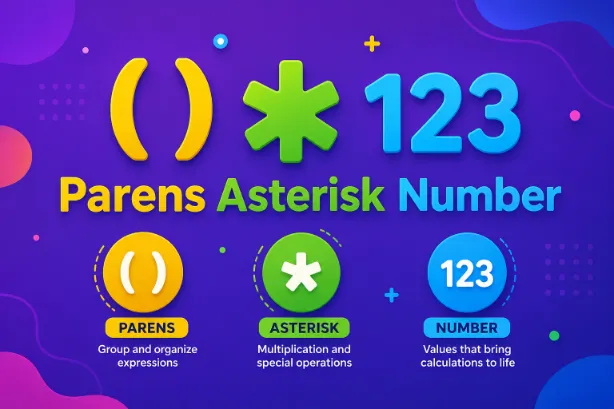
Main Uses of Parens, Asterisk, and Number Marks
| Mark | Shape | Common Purpose |
|---|---|---|
| Parens | ( ) | Extra details and source notes |
| Asterisk | * | Footnotes and special remarks |
| Number | 1, 2, 3 | Citation systems and references |
Editors choose a format based on publication style. Research journals may favor number systems, while blogs may lean toward simple bracket notes.
Citation Styles That Use These Marks
Several writing systems rely on these symbols.
| Style | Citation Form |
|---|---|
| APA | (Author, Year) |
| MLA | (Author Page) |
| Chicago | Footnotes with numbers |
| Scientific Journals | Superscript numbers |
APA and MLA formats place source notes inside parens. Chicago style usually uses numbered footnotes.
Why Writers Use Citation Marks
Citation marks support clean writing. Readers can track data origins without searching across many pages.
Benefits:
- Better source tracking
- Cleaner page layout
- Faster fact checking
- Clear research support
- Strong academic structure
Teachers and editors expect proper citation placement in formal writing. Missing source marks may create plagiarism problems.
Difference Between Footnotes and Parenthetical Citations
Many readers mix footnotes with parenthetical citations. Both methods point toward sources, yet page structure changes.
| Feature | Footnotes | Parenthetical Citations |
|---|---|---|
| Location | Bottom of page | Inside text |
| Marker | Asterisk or number | Parens |
| Reading Flow | Extra step | Direct source view |
| Common Fields | History and law | Academic essays |
History books rely on detailed notes. Modern research papers lean toward short parenthetical references.
Asterisk Use Across Digital Platforms
Social media apps, coding platforms, and messaging tools use the asterisk in many ways.
Examples:
- word for text emphasis
- Search commands such as file*
- Chat correction marks like *morning
- Password masking symbols
Computer science systems also use the symbol for wildcard matching.
Parens Use Across Everyday Writing
Parens appear across newspapers, advertisements, novels, and online posts.
Common uses:
- Extra explanations
- Date placement
- Acronym notes
- Translation support
- Humor or side comments
Examples:
- The train arrived late (again).
- NASA (National Aeronautics and Space Administration) launched another mission.
Parens help writers add short side remarks without breaking sentence flow.
Number Citation Systems in Research
Science and medical writing rely heavily on number citations. A superscript number usually appears after a statement.
Example:
- Researchers noted rapid cell growth² after treatment.
A numbered source list appears later in the paper.
Advantages:
- Saves page space
- Faster reading pace
- Cleaner visual design
- Easy source order
Medical journals favor this format due to dense technical material.
Common Errors With Citation Marks
Writers sometimes place citation marks incorrectly. Small mistakes may weaken readability.
Frequent errors:
- Missing closing parens
- Wrong footnote order
- Repeated citation numbers
- Footnotes without matching text
- Random asterisk placement
Editors check these details carefully during proofreading.
Proper Placement of Citation Symbols
Correct placement supports smooth reading.
Guidelines:
- Put periods after parenthetical citations in APA style.
- Place superscript numbers after punctuation marks in many scientific journals.
- Match every asterisk with a note.
- Keep citation style consistent across the full document.
Example:
- Air quality improved after policy changes (Khan 12).
Citation Symbols in Printed Books
Printed books use citation marks for references, translator notes, and author remarks.
Classic novels may place asterisks near difficult terms. Historical books may use numbered notes for source details.
Readers can move toward the notes section for deeper information without losing reading pace.
Role of Citation Marks in Academic Writing
Schools, colleges, and universities teach citation systems early. Research projects rely on proper source attribution.
Professors expect:
- Accurate references
- Consistent style
- Clean formatting
- Proper quotation support
Citation marks also support academic honesty. A clear source trail helps readers verify material.
Search Trends Around Parens Asterisk Number
Search traffic around “Parens Asterisk Number” rose after puzzle fans searched for the phrase during the NYT Connections game discussion. Online puzzle forums and gaming websites later described the phrase as a citation category.
Many readers searched:
- What does parens mean?
- Why do books use asterisks?
- How do number citations work?
- What marks point toward references?
Academic writing guides also receive regular traffic from students searching for citation help.
Modern Publishing and Citation Symbols
Digital publishing tools now automate citation placement. Word processors can generate:
- Footnotes
- Endnotes
- Reference lists
- Numbered citations
- Parenthetical references
Software such as Microsoft Word and Google Docs supports automatic numbering systems. Citation tools save time for students, teachers, journalists, and researchers.
Parens, asterisk, and number marks shape modern writing structure. These small symbols guide readers toward references, notes, and supporting material. Academic papers, books, websites, and legal files rely on them every day.
Parens support short source notes and extra remarks. Asterisks direct readers toward footnotes and special conditions. Number systems organize references across long research papers.
Clean citation habits improve readability, source tracking, and academic quality. Writers who master these symbols create polished documents with stronger organization and better reader trust.